

A majority of Canadians across the country want to see Canada become an “energy superpower” that prioritizes clean energy over fossil fuels, according to an internal federal government report.
The public opinion research report, prepared earlier this year by Environics Research, was commissioned by Natural Resources Canada to gauge “public opinion on Canada’s energy policies.”
The report, based on a survey of 3,084 Canadians in late March 2026, explains that the research was undertaken to better understand the public’s “priorities, values and concerns” to “support policy development and decision-making” as well as “guide communications strategies, messaging and speaking points for stakeholders.”
It specifically notes the Carney government has established a “goal for Canada to become an energy superpower,” a term that has figured prominently in Prime Minister Mark Carney’s political messaging and also appeared as a plank in the 2025 Liberal election platform.
According to the report, three-quarters of Canadians agree it is “extremely or very important” for Canada to become an energy superpower: “The survey results reveal broad public support for Canada becoming an energy superpower … Support is driven by a shared emphasis on energy independence and economic growth, but is conditional on strong environmental protections.”
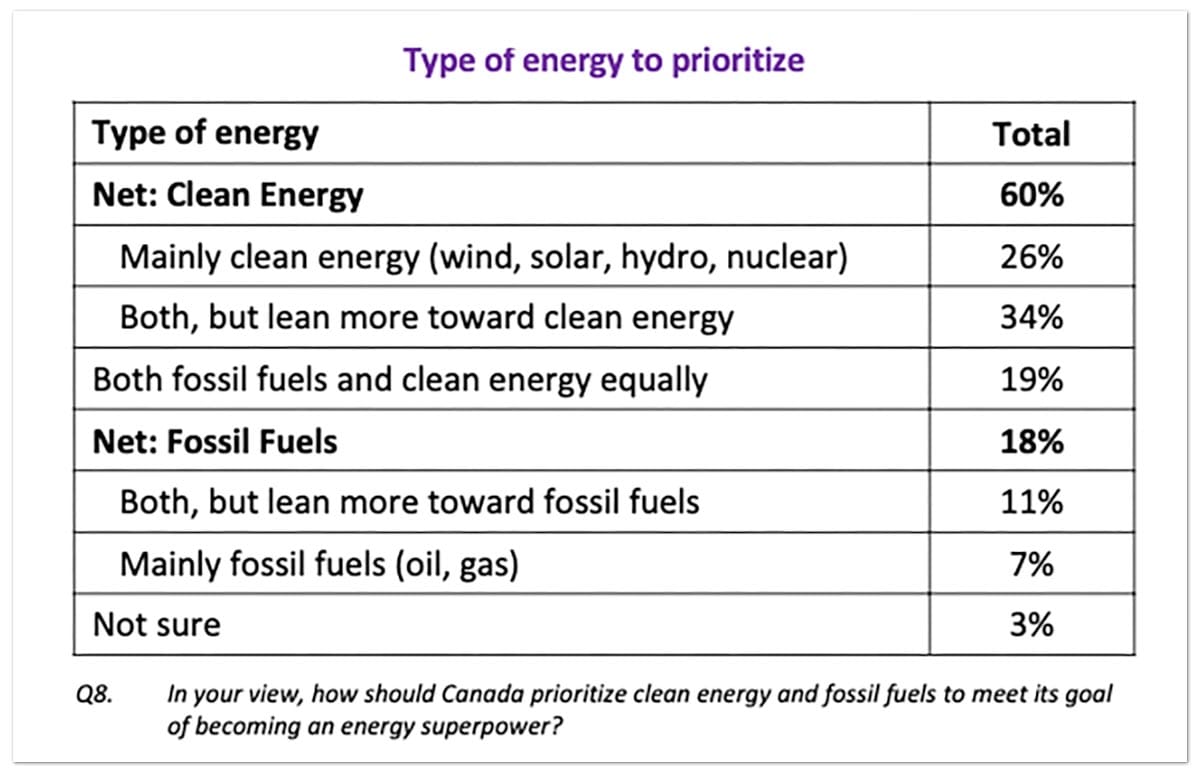
One of the report’s key findings is that it is the “dominant view” of Canadians across the country that Canada should become a superpower in clean energy — not fossil fuels.
“Belief that an energy superpower should lean to or mainly prioritize clean energy is the dominant view across the country, even in Alberta,” the report states. “The public is three times as likely to say clean energy rather than fossil fuels should be prioritized to meet the goal of becoming an energy superpower.”
Overall, 60% of Canadians indicated they want to prioritize clean energy compared to 18% who said the same of fossil fuels. Broken down further, one-quarter (26%) said Canada should focus mainly on clean energy, while one-third (34%) said “both, but lean more toward clean energy.”
Broken down provincially, net preference for clean energy is highest in Québec (72%), Ontario (62%) and the Atlantic provinces (62%). In Alberta, where the net preference for clean energy is lowest, more people nonetheless said they would prioritize clean energy (42%) over fossil fuels (32%).
In fact, a preference for clean energy cuts across nearly all categories, including age, gender and education. Even workers in the energy industry indicated a preference for clean energy (44%) over fossil fuels (39%) as did those who live in rural areas (54% preferred clean energy to 22% who preferred fossil fuels).
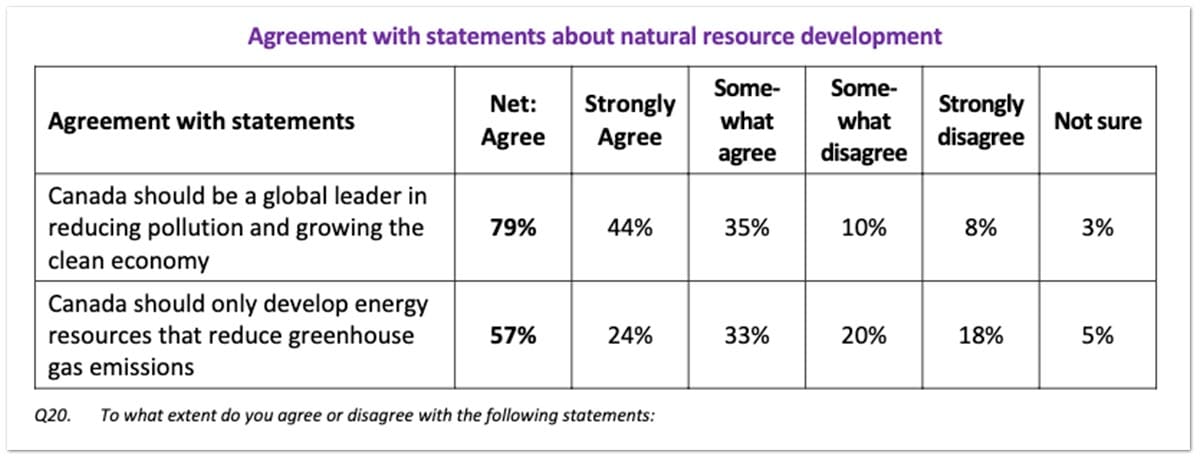
“Eight in ten Canadians agree that Canada should be a global leader in reducing pollution and growing the clean economy,” the report adds. “There is lower, but still almost six in ten majority agreement, that it should only develop energy
resources that reduce greenhouse gas emissions.”
The report highlights issues that could complicate the Carney government’s plans to make Canada an “energy superpower,” as well.
About one-third (35%) expressed concern about Canada “investing too heavily in fossil fuels while other countries move toward cleaner energy” while a significant number said they were concerned about “increased greenhouse gas emissions that cause climate change” (29%). Nearly half of respondents (48%) identified “environmental damage from energy projects” as a key concern.
Those findings in particular could throw a wrench in the Carney government’s “nation-building projects,” a number of which are marketed to the public as part of a vision to realize “Canada’s full potential as an energy superpower.”
Earlier this month, the Prime Minister’s Office described its new west coast oil pipeline as a “project of national interest to unlock Canada’s full potential as a global energy superpower.” Environmental groups have criticized the project, with estimates suggesting the new pipeline could generate 20 megatonnes per year in new emissions. Meanwhile Carney’s government recently passed legislation that would loosen environmental regulations and shorten timelines for environmental reviews.
The pipeline, widely seen as a concession to appease Alberta separatists, stands in contrast with what Carney told voters in the 2025 federal election.
At one campaign event in April 2025, Carney pledged to “make Canada the world’s leading energy superpower,” saying he would position Canada at the forefront of the “clean energy revolution.”
The report notes most Canadians currently rank Canada “in the middle” of energy-producing nations.


